Maternity Photo Poses: A Guide for Expecting Moms
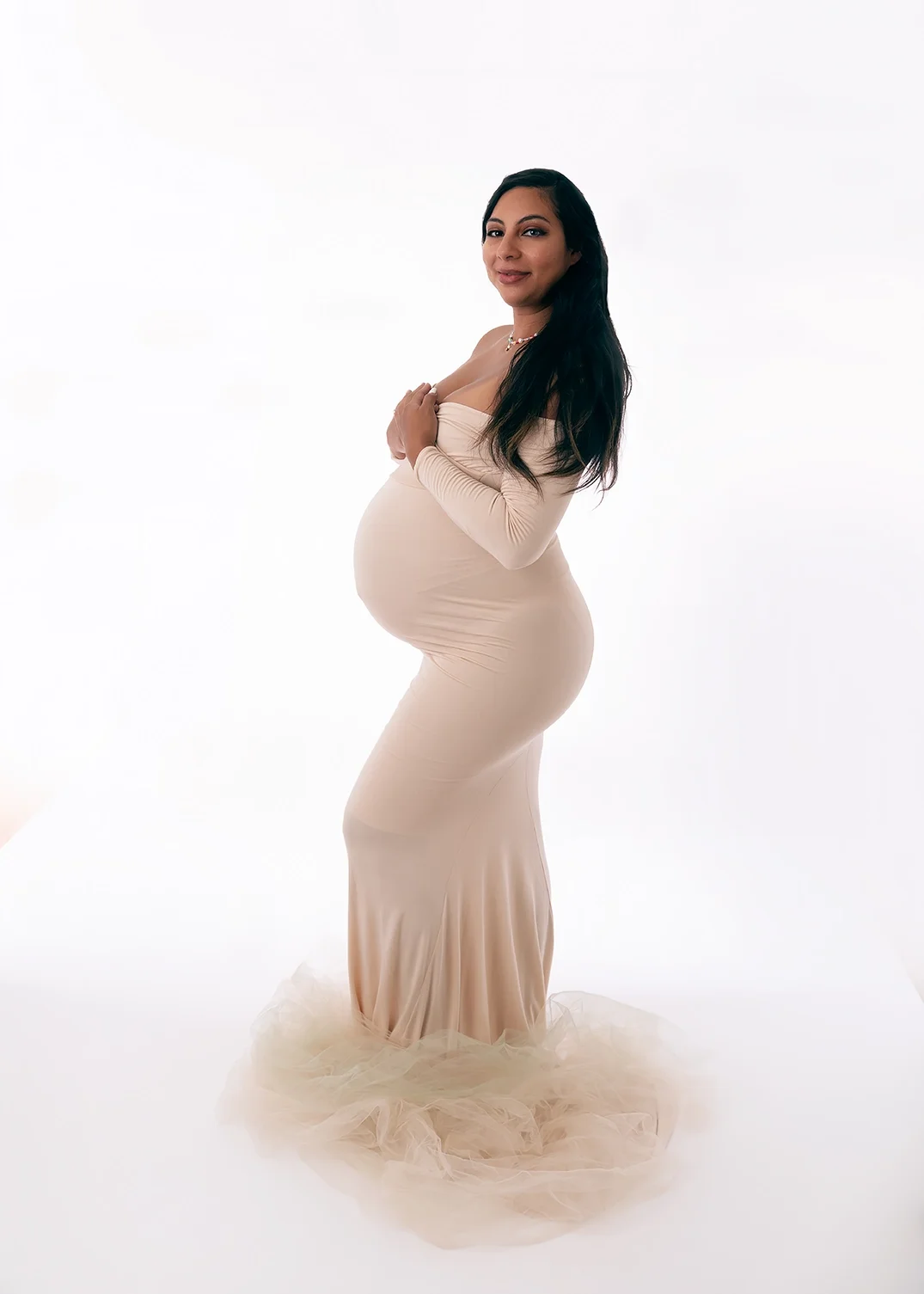
A fitted maternity gown can beautifully define the shape of the belly without requiring an elaborate pose. Turning the body slightly to the side creates a strong pregnancy silhouette, while simple hand placement and guided posing keep the portrait elegant and focused on Mom.
One of the most common concerns women have before a maternity photo session is posing.
What should I do with my hands? Where should I look? How should I stand? What if I don't feel comfortable with the way my body looks right now?
You don't need to know any of those things before your session.
Maternity posing is something I guide throughout the photography session. Small adjustments to your hands, shoulders, hips, chin, weight, and the direction of your body can completely change a photograph.
But posing maternity portraits isn't simply about finding the most flattering angle. For me, it is also about telling the story of this particular moment: a mother experiencing a body that is changing while she waits to meet the baby growing inside her.
Quick Answer: Do I Need to Know How to Pose for Maternity Photos?
No. You do not need modeling experience or need to know how to pose before a maternity photo session. Your photographer should guide your body position, hands, expression, and angles throughout the session.
Good maternity posing creates shape, emphasizes the pregnancy, and helps you feel comfortable in front of the camera. The goal isn't to make every woman fit the same pose. It is to photograph your body thoughtfully during this temporary and significant stage of motherhood.
Maternity Posing Is Different From Regular Portrait Posing
Maternity photography has a very specific visual focus: the shape of the pregnant body.
That changes the way I pose a maternity client.
Standing completely square to the camera, for example, may not show the belly as clearly as turning the body slightly. Moving one leg, shifting weight, changing the position of the shoulders, or adjusting the placement of a hand can create more shape and separation.
These adjustments may feel very small while you're standing in front of the camera, but they can make a significant difference in the finished portrait.
That's why you don't need to figure out maternity poses yourself. I will direct you throughout the session.
Your Hands Help Tell the Story
Hand placement is especially important in maternity photography.
Your hands can define the shape of your belly and naturally draw attention toward your pregnancy. One hand may rest above the belly while another rests underneath it. In other portraits, your hands may fall more naturally at your side, touch a gown, or become part of the overall composition.
The purpose isn't simply to give your hands somewhere to go.
They help direct the viewer's attention.
This is also why I don't necessarily want both hands placed around the belly in every photograph. A maternity gallery should have variety rather than repeating the same pose over and over again.
Why Shifting Your Weight Matters
Where you place your weight changes your posture and the overall shape of your body.
I may ask you to shift your weight onto one leg, bend the other knee slightly, turn your hips, or move one foot.
These aren't dramatic movements. Often they are subtle.
But small adjustments can create better lines through the body and prevent a pose from looking stiff.
Pregnancy also changes your center of gravity, so comfort and stability matter. A pose isn't useful simply because it photographs well if it is uncomfortable or difficult for you to maintain.
Shoulders, Chin and Face Angle Matter Too
Maternity posing isn't only about the belly.
The position of your shoulders, chin and face can change the entire feeling of a portrait.
I may ask you to bring your chin slightly forward, turn your face toward the light, lower your eyes, or angle your shoulders differently.
Again, you don't need to remember any of this.
I will guide you as we work.
For more about how this guidance fits into the complete session, see my What Happens During a Maternity Photo Session? guide.
You Don't Have to Look at the Camera in Every Maternity Photo
My maternity photography tends to include fewer images of Mom looking directly at the camera than you might see in a traditional portrait session.
That is intentional.
Of course, I create some portraits where Mom is looking toward the camera. But I am often more interested in the relationship between a woman and her changing body.
You may look down toward your belly, close your eyes, turn into the light, or simply become quiet for a moment.
Pregnancy isn't only happiness and excitement.
There is anticipation. There can be vulnerability, uncertainty, reflection and even fear. You are waiting for someone you haven't met yet while your body is changing to make room for them.
I don't think every maternity photograph needs to turn that experience into a smile directed at the camera.
Sometimes a quieter portrait says much more.
Why I Often Prefer Darker Backgrounds for Maternity Portraits
I frequently photograph maternity portraits against darker backgrounds.
Part of that choice is aesthetic. Dark backgrounds can create beautiful separation, depth and a more painterly quality while allowing light to define the face, belly and shape of the body.
There is also a practical reason.
Many expecting mothers tell me there are parts of their changing bodies they feel self-conscious about. Pregnancy can change much more than the belly, and not every woman feels completely comfortable with every physical change.
I take those concerns seriously without making them the focus of the session.
With thoughtful lighting, posing, wardrobe and a darker background, I can decide where light falls and where it doesn't. Rather than trying to conceal someone's body, I can use light to direct attention toward the areas we want to emphasize, particularly the face, hands and shape of the pregnancy.
The result can be dramatic, elegant and very forgiving without making the photograph feel as though we're trying to hide Mom.
Maternity Photography Isn't About Making You Look Thinner
This distinction matters to me.
When photographers talk about "flattering poses," it can sometimes sound as though the goal is to make every woman appear smaller.
That isn't how I approach maternity photography.
You're pregnant. Your body is supposed to look different.
Good maternity posing is about creating shape, posture, balance and separation. It is about emphasizing the belly and photographing the body intentionally.
If you tell me there is something you're uncomfortable emphasizing, I can take that into consideration when choosing wardrobe, lighting and camera angles.
That is different from treating your body as something that needs to be corrected.
Standing Maternity Poses
Standing portraits are particularly useful for showing the full shape of the pregnant body.
Rather than standing completely straight toward the camera, I may turn your body, shift your weight, change the position of your feet, or adjust your arms and hands.
Standing poses also work beautifully with fitted maternity gowns because they allow the silhouette of the belly to become an important part of the composition.
Flowing fabrics can create an entirely different effect.
For more information about choosing clothing for your session, see my What to Wear for Maternity Photos guide.
Seated Maternity Poses
Not every maternity photograph needs to be standing.
Seated portraits give us different body lines and can create a quieter, more intimate feeling.
They also give Mom an opportunity to rest.
How I position the legs, torso, shoulders and hands still matters because we want the belly to remain visible and the pose to look intentional.
As with standing portraits, I'll guide each adjustment.
Floor and Lying-Down Maternity Poses
Some of the most beautiful maternity portraits can be created closer to the floor.
Sitting on the floor allows us to create softer, more relaxed body lines than we can achieve in a traditional standing or seated pose. Depending on the wardrobe, fabric can be arranged around the body to become part of the composition, creating portraits that feel elegant and almost painterly.
Lying-down poses can also be beautiful during pregnancy. From above or from carefully chosen angles, these poses can emphasize the curve of the belly while creating a quieter, more intimate portrait. Hands, fabric, hair, and the direction of the face can all be used to guide attention through the image.
These poses require particularly careful positioning. The placement of the legs, shoulders, arms, and belly can dramatically change how the body photographs, so I guide Mom through the pose rather than expecting her to know how to arrange herself.
Comfort and safety also come first. Not every floor or lying-down pose is appropriate or comfortable for every stage of pregnancy. I adjust the pose based on how Mom is feeling and what she can comfortably do that day.
I particularly like these poses because they can feel less like a conventional portrait and more like a study of shape, motherhood, and the pregnant body. They also give us another way to create variety without simply changing the backdrop or maternity gown.
Close-Up Maternity Portraits
Some maternity photographs don't need to show the entire body.
Closer compositions can concentrate on the belly, hands, face, or relationship between Mom and her unborn baby.
These images are particularly useful for creating variety in a maternity gallery.
A close portrait of Mom looking toward her belly can communicate something entirely different from a formal full-length gown portrait, even though both were created during the same session.
Maternity Gowns and Fabrics Change the Way We Pose
Wardrobe and posing work together.
A fitted maternity gown shows the shape of the body differently from flowing fabric. A dramatic gown may need to be arranged carefully to create the right lines. Draped fabric may become part of the pose itself.
That is one reason we discuss wardrobe before and during the session rather than treating clothing as an afterthought.
Different looks give us opportunities to create different types of portraits instead of simply changing clothes and repeating the same poses.
Posing With Your Partner
When a partner joins the session, posing becomes less about positioning two people independently and more about creating connection between them.
I may have your partner stand behind you, place a hand on your belly, look toward you, or interact with you rather than looking directly at the camera.
We can still create a traditional portrait of both of you looking toward the camera, but those aren't necessarily the photographs that communicate the most.
The pregnancy belongs to your family's story, and your relationship can be part of documenting it.
What If I Don't Like Part of My Body During Pregnancy?
Tell me.
You don't need to apologize for it, and you don't need to explain why.
Many women experience complicated feelings about their bodies during pregnancy. You can be grateful for what your body is doing and still feel uncomfortable with some of the changes.
Those things aren't contradictory.
If there is an area you would rather not emphasize, knowing that helps me make decisions about posing, wardrobe, lighting and camera angle.
Photography gives us considerable control over where the viewer's attention goes. My goal isn't to convince you that you're wrong about how you feel. My job is to understand your concerns and photograph you thoughtfully.
You Don't Need to Recreate Maternity Poses From Pinterest
Pinterest can be useful for communicating a general style you like, but you don't need to arrive with a collection of poses to reproduce.
A pose that works beautifully for one woman may not work the same way for another because bodies, pregnancies, clothing and proportions are different.
I would rather use an image as inspiration and then create something appropriate for the person standing in front of my camera.
Your maternity portraits should not feel like a checklist of photographs we've copied from someone else's session.
What If I Feel Awkward While I'm Being Posed?
Feeling awkward doesn't necessarily mean you look awkward.
Some of the positions photographers use can feel unfamiliar because people don't normally think consciously about the exact angle of their shoulders, hands, feet and chin.
I'll continue making adjustments while watching how the pose photographs.
You aren't responsible for determining whether the pose is working. That's part of my job behind the camera.
Frequently Asked Questions About Maternity Photo Poses
Do I need modeling experience for maternity photos?
No. Most maternity clients are not models. You will be directed throughout the session, including your hands, body position, face and where to look.
What are the most flattering maternity poses?
There isn't one pose that works best for everyone. Turning the body, shifting weight, carefully positioning the hands, and adjusting the shoulders and face can help define the belly and create strong body lines.
Do I have to smile in my maternity photos?
No. We can create smiling portraits as well as quieter images. Looking toward your belly, looking away from the camera, or using a more reflective expression can create maternity portraits with a very different emotional quality.
Can maternity posing hide areas I'm self-conscious about?
Posing, wardrobe, lighting, camera angle and background choice can all influence which areas receive visual emphasis. If you have a particular concern, tell your photographer before or during the session so it can be considered when creating your portraits.
Why do photographers have pregnant women hold their bellies?
Hand placement helps define the shape of the belly and directs attention toward the pregnancy. However, every maternity photograph does not need to use the traditional two-hands-on-the-belly pose.
Are standing or seated maternity poses better?
Both can work beautifully. Standing poses are excellent for showing the overall silhouette, while seated poses create different body lines and often have a quieter feeling. Using both creates more variety.
Can my partner be included in maternity poses?
Yes. Partner portraits can include both traditional poses and more connected images in which you interact with one another rather than looking directly at the camera.
Maternity Photography in Los Angeles
At my private Tujunga studio, I photograph maternity sessions for women throughout Los Angeles, Glendale, Pasadena, Burbank, La Cañada Flintridge, La Crescenta and surrounding communities.
You don't need to arrive knowing how to pose, and you don't need to feel completely confident about every change pregnancy has made to your body.
We use posing, lighting, wardrobe and expression intentionally, not to turn you into someone else, but to decide what the photograph is actually about.
For me, maternity photography is ultimately about more than documenting the size and shape of a pregnant belly.
It is about the woman carrying that baby, her relationship with her changing body, and the anticipation, vulnerability and uncertainty that exist alongside the excitement of waiting to meet her child.
Continue Learning
For more help planning the entire experience, see my guide to maternity photography in Los Angeles
When Is the Best Time for Maternity Photos?
Learn when to schedule your maternity session so your belly is beautifully defined while you are still comfortable posing.
How to Prepare for a Maternity Photoshoot
From planning your wardrobe to getting ready for the studio, these tips can help you prepare for your maternity portraits.
Studio vs. Outdoor Maternity Photos: Which Is Better?
Compare studio and outdoor maternity photography to decide which setting best fits the look you want.
Explore Photography Sessions
Maternity Photography
Explore studio maternity photography in Los Angeles, including wardrobe, guided posing, family portraits, and session information.
Newborn Photography
Plan ahead for your baby's first portraits with a customized newborn photography session.
Mommy & Me Photography
Document the relationship between mother and child with portraits focused on connection and motherhood.