Should You Tell Your Child Santa Isn't Real?
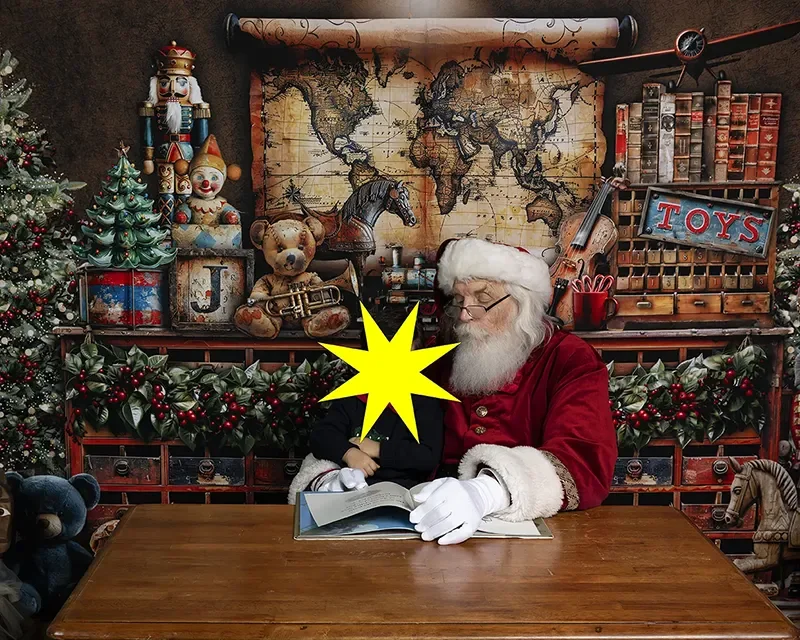
Believing in Santa is about more than accepting a story as literally true. For many children, it creates space for imagination, wonder, generosity, and meaningful family traditions. Quiet moments such as reading with Santa can preserve that sense of magic while giving parents room to follow their child’s questions and decide when an honest conversation feels right.
Planning your Santa photos? My Complete Guide To Santa Photos In Los Angeles answers everything from what to wear to what to ask.
Why the Magic of Santa May Matter More Than Having the "Right" Answer
Sooner or later, almost every parent hears the question:
"Is Santa real?"
It's one of childhood's biggest mysteries, and one that every family answers differently.
Some parents choose complete honesty from the very beginning.
Others embrace the magic of Santa for as long as possible.
Many families find themselves somewhere in the middle, allowing their children to wonder, imagine, ask questions, and slowly discover their own answers as they grow.
After photographing hundreds of children with Santa—and spending more than twenty years as a special education teacher—I've come to believe something important:
The most valuable part of Santa isn't proving whether he's real.
It's the wonder he inspires. This is why it is important to find a photographer who themselves really enjoy the Santa Experience. Here are The Questions Parents Need To Ask Their Santa Photographer
Childhood Needs Wonder
Children spend much of their early years learning how the world works.
They ask endless questions.
Why is the sky blue?
How do airplanes fly?
Why do leaves fall?
Their curiosity is one of the greatest gifts of childhood.
At the same time, children naturally fill their world with imagination.
They pretend.
They invent stories.
They create imaginary friends.
A cardboard box becomes a spaceship.
A blanket becomes a castle.
A stick becomes a magic wand.
This ability to imagine possibilities is an important part of healthy childhood development. Through imaginative play, children practice creativity, language, problem-solving, perspective-taking, and flexible thinking—all skills they continue to use throughout life.
Santa becomes part of that wonderful world where imagination and possibility meet.
Maybe the Better Question Isn't "Is Santa Real?"
Perhaps the better question is:
"What does believing in something magical give a child?"
For many children, Santa represents far more than presents.
He represents kindness.
Generosity.
Hope.
Wonder.
The excitement of believing that extraordinary things might happen.
Those experiences become part of how children make sense of the world around them. One thing I also look back to are films by Ron Howard. If you look through his movies, almost all of them have an element of magic; something that is not quite explainable. I think I like to believe my Santa Experience has that magical element. These are the things that make a Santa Experience truly magical.
Children Love Solving Mysteries
One of my favorite things about children is that they don't simply accept everything they're told.
They investigate.
They notice details.
They ask difficult questions.
Sometimes they begin wondering:
"How does Santa visit every house?"
"How did Santa know my name?"
"How did my name get on the Nice List?"
Those questions are wonderful.
Curiosity should be encouraged.
Children don't need adults to solve every mystery immediately.
Sometimes the process of wondering is just as valuable as finding the answer.
Miracle on 34th Street Got It Right
One of my favorite Christmas movies is Miracle on 34th Street.
The story isn't really about proving Santa exists.
It's about something much deeper.
It reminds us that not everything meaningful can be measured, explained, or proven with absolute certainty.
The magic comes from allowing ourselves—especially children—to imagine that perhaps the world is a little more wonderful than we thought.
Whether Santa lives at the North Pole isn't really the point.
The point is that wonder has value.
What Happens in Santa's Workshop
One of the reasons I designed Santa's Workshop Photos differently is because I wanted children to experience that sense of wonder for themselves.
Before families arrive, Santa already knows each child's name.
Their name is waiting on the Nice List.
Santa may invite them to help unpack his workshop bag.
They might discover his magical globe.
Perhaps they'll learn a secret Santa handshake or share a Christmas wish.
Some children leave convinced they met the real Santa.
Others quietly wonder.
Still others simply enjoy spending time with someone who treated them with kindness and genuine interest.
Every reaction is welcome.
The goal isn't to convince children of anything.
It's to create a memorable experience that encourages imagination, conversation, and joy.
What If Your Child Already Has Doubts?
Many parents worry they've "missed the window."
Maybe an older sibling shared a secret.
Maybe a classmate said Santa isn't real.
Maybe your child has started connecting the dots.
That's perfectly normal.
In my experience, children don't suddenly stop enjoying Santa because they've begun asking questions.
In fact, many older children appreciate the experience in a different way.
They notice the details.
They enjoy the storytelling.
They become part of the tradition.
The magic evolves instead of disappearing.
The Memories Last Much Longer Than the Belief
Eventually every child grows older.
Their understanding changes.
But something remarkable happens.
Years later they don't usually remember exactly what gifts they received.
They remember finding their name on Santa's Nice List.
They remember Santa greeting them by name.
They remember helping him unpack his workshop.
They remember laughing together.
Those moments remain meaningful long after childhood has passed.
Every Family Writes Their Own Santa Story
There isn't one "correct" way to celebrate Santa.
Every family has its own traditions, beliefs, and conversations.
My hope is simply that every child who visits Santa's Workshop leaves with something that lasts longer than a photograph.
A sense of wonder.
A story to tell.
A reason to ask another question.
A memory that becomes part of their family's Christmas tradition.
Because whether Santa is a magical visitor from the North Pole or a beloved holiday tradition, childhood is one of the few seasons in life where imagination and reality are allowed to walk hand in hand.
And perhaps that's a little bit of Christmas magic all by itself.