Mommy & Me Posing: How to Look Natural With Your Children
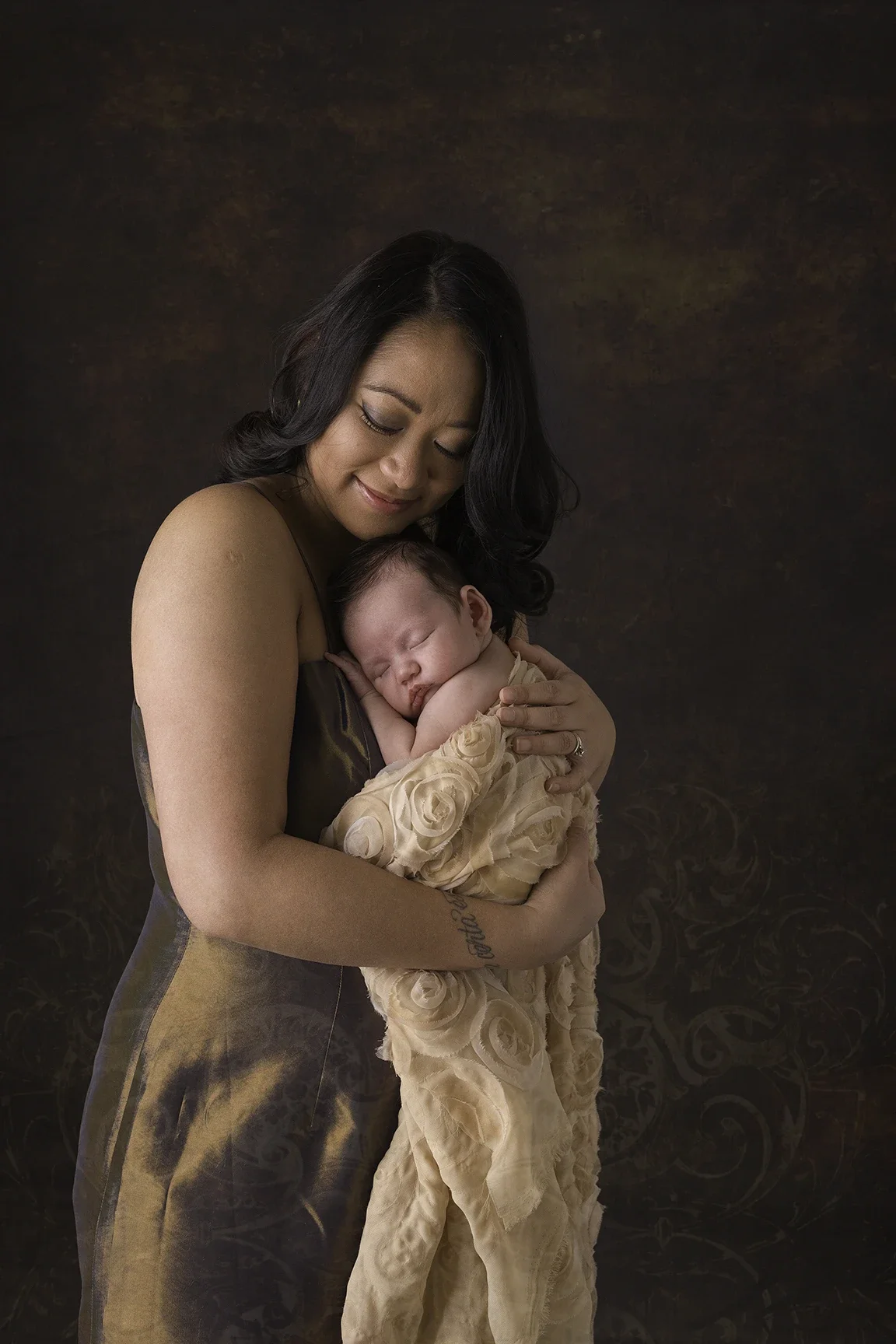
A quiet newborn portrait of mother and baby emphasizes closeness, scale, and connection. Mommy & Me posing does not need to feel complicated or overly formal; simple direction, supportive positioning, and natural interaction can create a polished portrait while preserving the intimacy of the moment.
One of the most common concerns moms have before a Mommy & Me photo session is posing.
What am I supposed to do with my hands?
Where should I look?
How do I hold my child without looking awkward?
What if I am uncomfortable in front of the camera?
The answer is that you should not have to figure these things out yourself.
Natural-looking Mommy & Me portraits are not necessarily unposed. In fact, many photographs that appear relaxed and effortless involve careful decisions about body position, hands, posture, lighting, and where Mom and her children are placed in relation to each other.
The goal of posing is not to make you look posed.
It is to create a flattering structure that allows the relationship between you and your children to become the focus of the photograph.
You Do Not Need to Know How to Pose
Most people are not naturally comfortable standing in front of a professional camera.
That is normal.
During a Mommy & Me session, I provide direction throughout the photography.
I may adjust:
Your shoulders
The angle of your body
Your chin
Your hands
Your posture
Where you place your weight
How you hold your child
Where your child sits or stands
Where you look
How close you are to your children
These adjustments are often small, but they can make a substantial difference in the finished portrait.
You do not need to arrive knowing your "good side" or having practiced poses in the mirror.
Natural Does Not Mean Unposed
There is an important difference between a photograph that looks natural and a photograph with no direction.
If I simply tell Mom and her children to stand together and "act natural," they may not know what to do.
Hands end up in awkward places. Bodies may be too far apart. Shoulders become tense. Children may block Mom. Everyone starts wondering where they are supposed to look.
Instead, I create the basic structure of the portrait first.
Once everyone is positioned well, I can introduce interaction.
That is often what creates the relaxed appearance.
The posing provides the structure.
The interaction provides the connection.
Start With Mom's Pose
In a Mommy & Me portrait, I often begin by positioning Mom.
This matters because adding a child can change Mom's posture immediately.
A child on your hip may cause you to lean backward. A toddler in your lap may make you round your shoulders. Holding a baby can cause you to raise one shoulder or twist your body without realizing it.
I may first adjust Mom's body angle, shoulders, legs, or hands, and then bring the child into the composition.
That allows me to create a pose that works for Mom and her child.
Not Every Pose Flatters Every Woman
There is no universal Mommy & Me pose that works equally well for everyone.
Women have different heights, proportions, body shapes, clothing, and comfort levels.
Children are different sizes too.
A pose that works beautifully for a mother holding a six-month-old may make no sense for a mother standing beside a ten-year-old.
Professional posing requires adjustment.
I may change the camera angle, turn Mom slightly, move an arm, reposition the child, or alter how Mom is sitting or standing.
The objective is not to make every mother fit the same pose.
The pose should fit the mother.
What Should I Do With My Hands?
Hands are one of the details that can make a portrait feel either polished or awkward.
Fortunately, Mommy & Me photography gives Mom something natural to do with them.
You may:
Hold your baby's body
Rest a hand on your child's back
Hold your child's hand
Wrap an arm around your child
Touch your child's hair
Rest your hand gently on a shoulder
Hold your toddler in your lap
Place a hand around your child's waist
I will direct your hands when necessary.
The important thing is that they look intentional without becoming rigid.
How Should I Hold My Baby?
How you hold your baby depends on age and developmental ability.
A newborn requires complete support.
An older baby may be held upright.
A sitting baby may sit in your lap or beside you.
A mobile baby may be happiest on your hip or standing with support.
The baby's safety and comfort determine what is possible first.
Then I refine Mom's position around that.
Sometimes moving the baby only a few inches higher or lower changes the entire composition.
The goal is to make the connection look natural while still creating a flattering portrait of Mom.
How Do You Pose With a Toddler?
Toddler posing needs to happen quickly.
A toddler may not remain exactly where we put them for long, so I generally avoid building a complicated pose that requires several minutes of cooperation.
Instead, we can use positions that already make sense to the child:
Sitting in Mom's lap
Being held
Standing beside Mom
Holding hands
Leaning against Mom
Hugging
Sitting together
Walking toward Mom
Once the basic position is established, I can adjust Mom rather than expecting the toddler to make ten tiny changes.
With toddlers, simplicity usually gives us more opportunities to capture the right moment.
Toddler sessions also require more flexibility than sessions with older children. For a closer look at movement, cooperation, breaks, and realistic
expectations, read Mommy & Me Photos With Toddlers: What to Expect.
You Do Not Always Need to Look at the Camera
A Mommy & Me gallery should not consist entirely of everyone looking directly into the lens.
Some portraits should have direct eye contact.
Others can focus on the relationship.
I may ask you to look at your child while your child looks at you.
You may look down at your baby.
Your toddler may rest against you.
You may both look toward the camera while holding each other.
Changing where people look creates different kinds of portraits without completely changing the pose.
Looking at Your Child Should Still Be Directed
"Look at your child" sounds simple, but even this can benefit from direction.
Turning your entire head too far may hide your face from the camera.
Dropping your chin too much can create an unflattering angle.
Looking down without changing anything else can appear disconnected rather than affectionate.
I may adjust the angle of your face while asking you to look toward your child.
That allows the photograph to show the interaction while still photographing Mom well.
Connection Often Comes From Physical Contact
When people are physically separated in a portrait, they can look disconnected even when they are standing close together.
Touch helps create visual connection.
That might mean:
A child's hand on Mom
Mom's arm around a child
Foreheads close together
A toddler leaning against Mom
Holding hands
A baby against Mom's chest
Children tucked closely beside her
Not every photograph needs a dramatic hug.
Sometimes one hand or a slight lean is enough to connect the composition.
What About Forehead-to-Forehead Poses?
These can work well, especially with babies and younger children, but they should not become the default pose for every photograph.
The position needs to be comfortable and believable.
With a baby, bringing faces close together can emphasize scale and intimacy.
With an older child, a quieter face-to-face pose may work better than trying to reproduce something designed for a newborn.
The child's age should influence the interaction.
Should I Smile in Every Photograph?
No.
A complete Mommy & Me gallery can include different expressions.
Some photographs may include a traditional smile toward the camera.
Others may show Mom smiling at her child.
Some may be quiet or serious.
Painterly portraits in particular can work beautifully with softer expressions.
Expression should support the mood of the photograph rather than becoming an automatic instruction to smile in every frame.
How Do I Avoid Looking Stiff?
Stiffness often comes from trying too hard to hold a position.
Once the basic pose is established, I may ask for a small action instead of asking you to remain completely frozen.
That could mean looking at your child, adjusting your embrace, talking quietly, holding hands, or responding to something your child is doing.
Small movements can soften posture and expression.
The photograph still has structure, but it no longer feels static.
Your Shoulders Matter
Shoulder position has a significant effect on portraits.
When people feel nervous, shoulders often rise.
Holding a child can exaggerate this.
I may ask you to lower a shoulder, turn slightly, or relax your upper body.
These are minor adjustments that can make the pose look considerably more comfortable.
Your Chin Matters Too
Chin position affects the face and jawline.
People often instinctively pull their head backward when a camera is pointed at them.
That is rarely the most flattering position.
I may ask you to bring your face slightly forward, lower or raise your chin, or turn toward the light.
The adjustment may feel unfamiliar because it is being designed for a two-dimensional photograph rather than for how the position feels in everyday life.
Seated Mommy & Me Poses
Seated portraits work particularly well with babies and young children.
Mom may sit in a chair, on a posing surface, or closer to the floor depending on the composition.
Children can sit:
In Mom's lap
Beside Mom
Between Mom's arms
Slightly in front of Mom
Leaning against her
On either side when there is more than one child
Seated posing gives us considerable control over height differences and makes it easier to bring faces closer together.
Standing Mommy & Me Poses
Standing portraits can feel elegant and work particularly well with older children.
Mom may hold a younger child or stand beside an older one.
With several children, standing poses can help create a balanced composition without everyone being arranged at the same height.
Again, the exact pose depends on the people being photographed.
Height differences, clothing, children's ages, and the overall portrait style all influence the arrangement.
Posing With More Than One Child
Adding children increases the complexity of the composition.
The objective is not simply to place one child on each side of Mom.
I look at how the faces, bodies, hands, and clothing work together.
We may create:
Mom with all children
Mom holding the youngest with an older child beside her
Children seated around Mom
Children leaning toward Mom
Mom with each child individually
Close group portraits
Standing compositions
Seated compositions
Individual Mom-and-child portraits are particularly useful because they allow us to create a pose specifically for that relationship without trying to accommodate everyone at once.
Painterly Posing Is More Deliberate
For a painterly Mommy & Me portrait, posing may be more structured.
Hands, body angles, clothing, and the placement of each child become part of the overall composition.
The lighting is also designed around the pose.
These portraits can feel formal without looking rigid.
The objective is to create the sense of a carefully composed heirloom portrait rather than a casual snapshot.
Contemporary Posing Can Be Simpler
For a cleaner, more contemporary look, the posing may become less formal.
The background may be simpler, the wardrobe lighter, and the interaction more relaxed.
That does not mean posing disappears.
The same principles of flattering body position, hands, posture, and composition still apply.
They are simply less visually obvious.
Outfit Changes Can Change the Posing
If we create two wardrobe looks during your session, I may also change the posing style.
A formal gown may lend itself to a carefully composed seated portrait.
A simpler second outfit may work better for closer interaction, standing portraits, or a more relaxed composition.
Wardrobe, posing, background, and lighting should work together.
Changing the clothing without reconsidering the pose can miss an opportunity to create genuinely different photographs.
Clothing also affects how I can pose Mom and her children. A flowing gown, fitted dress, or more casual outfit each creates different possibilities. For
more help planning both looks, see What to Wear for Mommy & Me Photos.
What If My Child Will Not Do the Pose?
Then we change it.
Children are not props that can be positioned indefinitely.
A toddler may refuse to sit beside Mom but happily climb into her lap.
A baby may turn toward Mom instead of toward the camera.
An older child may feel uncomfortable with an interaction that would have been natural several years earlier.
The pose has to make sense for the child as well as Mom.
If something does not work, there are usually other ways to create the photograph.
Refusing a particular pose does not mean the session is going badly. There are usually several other ways to create the portrait. I explain this in more
detail in What If My Child Won’t Cooperate for Mommy & Me Photos?
The Best Mommy & Me Poses Show Relationship
Good posing should help people understand who is connected to whom.
That connection can come through eye contact, touch, proximity, body language, or expression.
The photograph does not need to look candid.
It does need to look believable.
A carefully posed portrait can still show genuine affection.
A relaxed portrait can still be carefully constructed.
Those ideas are not opposites.
You Should Not Have to Think About Posing During the Session
You do not need to memorize posing tips before your Mommy & Me photos.
Understanding why posing matters can help you know what to expect, but the actual direction should happen during the session.
I will tell you where to stand, where to look, how to position your hands, and when an adjustment is needed.
Your job is not to monitor your body from head to toe while also trying to connect with your children.
Once the structure is in place, you can concentrate on them.
That is when the portrait begins to feel natural.
Planning Mommy & Me Photos in Los Angeles?
Professional Mommy & Me posing combines flattering direction for Mom with age-appropriate positioning for babies, toddlers, and older children.
The goal is not to make every mother and child perform the same set of poses.
It is to use posing, lighting, composition, and interaction to create portraits that work for the people actually in front of the camera.
Natural-looking Mommy & Me photos do not require you to know how to pose.
They require direction that does not call attention to itself.
Continue Learning
The Complete Guide to Mommy & Me Photography in Los Angeles
Explore the complete planning guide for Mommy & Me portraits, including ages, wardrobe, babies, toddlers, session preparation, and what to expect.
Best Ages for Mommy & Me Photos
See how mother-and-child portraits change from newborns and sitting babies through toddlers, older children, teens, and adult children.
What Happens During a Mommy & Me Photo Session?
Learn how a studio session is planned, how posing and interaction are directed, and how different portrait styles are created.
Mommy & Me Photos With a Baby: What to Expect
Learn how posing and interaction change throughout your baby’s first year, from being held and cuddled to sitting, crawling, and standing.
Mommy & Me Photography at Panos Productions Photography
Explore private studio Mommy & Me portraits in Los Angeles, including painterly and contemporary photography styles.