Newborn Photos With Siblings: What Parents Should Know
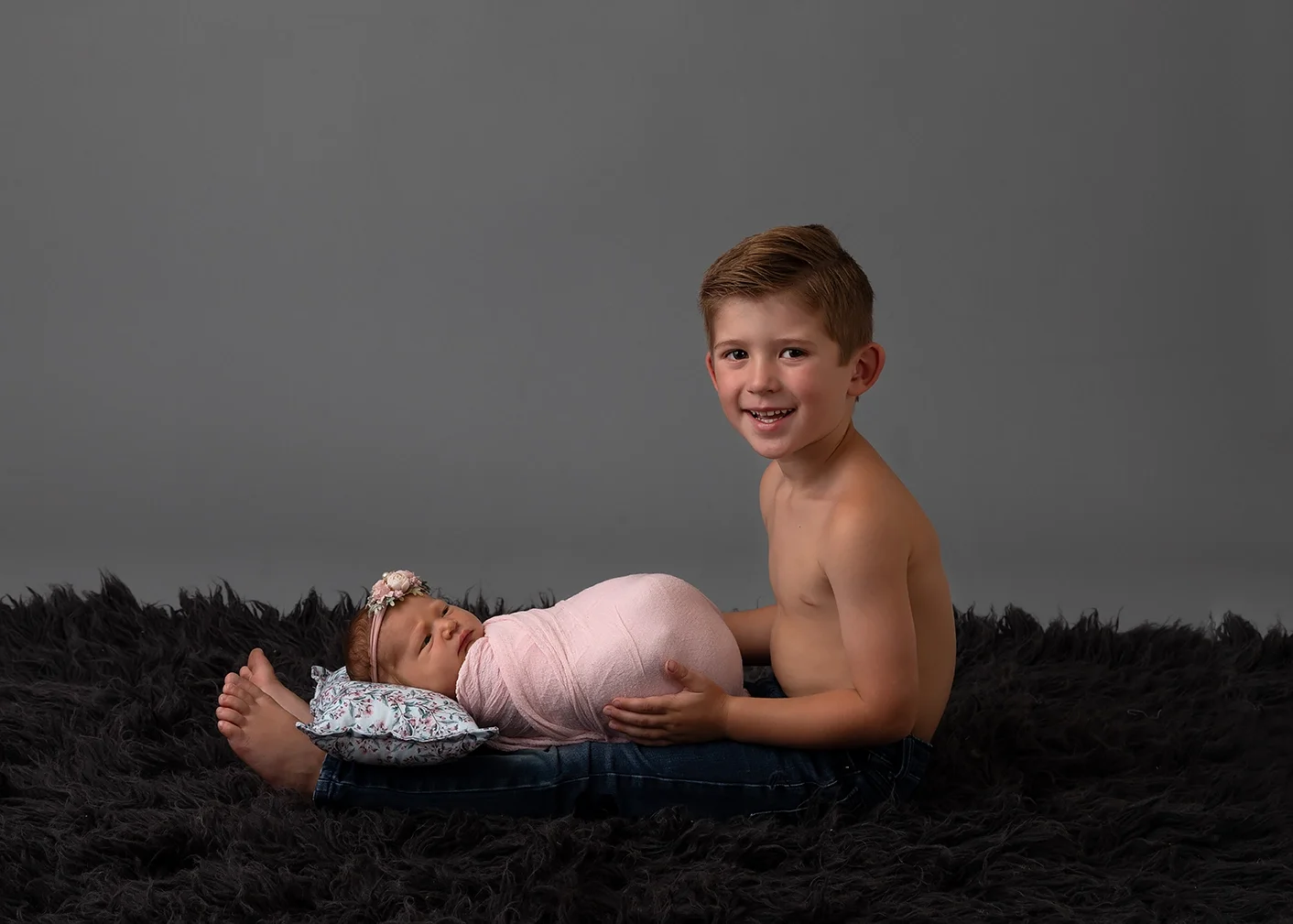
Sibling portraits can be especially meaningful when an older child is comfortable enough to hold the new baby. With older siblings, there are usually more posing options because they can follow directions and help support the newborn. I still carefully position and support the baby so the focus can stay on creating a natural connection between the children.
Adding a new baby to the family changes more than your daily routine. An older child suddenly becomes a big brother or sister, and those first photographs together can become some of the most meaningful images from a newborn session.
They can also be some of the most unpredictable.
Parents often worry about this part of their session:
Will my toddler hold the baby?
What if my child won't sit still?
What if they don't want anything to do with their new sibling?
Can they safely be photographed together?
After photographing hundreds of newborns and working with children of many different ages and personalities, I've learned that successful sibling photographs require two things: a safe setup and realistic expectations.
Sometimes we get the photograph almost immediately. Sometimes it takes quite a bit of patience.
Both are completely normal.
Can Siblings Be Included in Newborn Photos?
Yes. Siblings can be included in newborn sessions when your chosen package includes family photographs.
How I photograph them together depends heavily on the older child's age.
A five-year-old and a two-year-old shouldn't be approached in the same way. Their ability to follow directions, remain still, understand what we're doing, and safely interact with a newborn can be completely different.
Rather than trying to fit every family into the same sibling poses, I choose setups based on the children in front of me.
Can a Toddler Safely Hold a Newborn for Photos?
In many cases, yes, but the setup needs to be designed specifically for a young child.
Toddlers don't have the strength, coordination, or attention span of an older child. I don't simply place a newborn in a toddler's arms and expect them to support the baby.
Instead, I can use tools such as special positioning pillows and wraps to help support and secure the newborn while creating the appearance of the younger sibling holding the baby.
Safe newborn photography involves much more than choosing a pose. If you're wondering how babies are supported, handled, and protected throughout a session, read Is Newborn Photography Safe? What Parents Should Know.
These supports allow me to create sibling portraits while reducing how much responsibility is actually being placed on the toddler.
Depending on the children's ages and behavior that day, another option may work better. They might lie beside one another, the toddler might sit next to the baby, or we may create a completely different interaction.
The photograph has to fit the children. The children don't have to fit a predetermined pose.
Sibling Photos With Children Five and Older
Once an older sibling is around five or older, I usually have many more posing possibilities.
Older children can generally understand directions better, stay in position longer, and interact with their new sibling more intentionally.
Depending on the individual child, we may be able to photograph them:
Holding the newborn
Sitting together
Lying beside the baby
Looking at or talking to the baby
Gently cuddling or touching the newborn
Looking toward the camera together
Interacting naturally rather than posing
Of course, age isn't everything. Some five-year-olds are extremely comfortable holding a new sibling, while others aren't.
I never want a child to feel that they have to hold the baby simply because they're old enough.
What About Newborn Photos With Toddlers?
Toddlers are usually the most unpredictable age for sibling photographs.
Sometimes they surprise everyone and do exactly what we need within a few minutes.
Sometimes they don't.
A toddler may refuse to sit down. They may want Mom. They may want nothing to do with the baby. They may sit exactly where we need them and then get up two seconds later.
And sometimes it simply takes time to get the photograph.
This is one reason I don't want parents to become concerned when sibling photographs aren't happening immediately.
Young children aren't professional models, and I don't expect them to behave like they are.
We may try one setup and then another. We may take a break. We may use distraction. We may let the child become comfortable with the space before trying again.
There are sessions where getting one sibling photograph takes considerably longer than expected.
That's okay.
I Usually Photograph the Newborn First
At my studio, I generally complete the newborn portion of the session first.
This gives me time to concentrate completely on the baby and create the newborn images included in the session.
Once the newborn portion is finished, we transition into the sibling photographs.
I find that this creates a natural progression through the session:
Newborn → Siblings → Parents → Whole Family
The newborn portion itself moves at your baby's pace, with time for feeding, soothing, wrapping, and posing. You can read What Happens During a Newborn Photography Session? for a closer look at the entire experience.
If your package includes parent and family photographs, sibling portraits flow naturally into those images.
Once the older child is already involved and everyone is together, we can transition into photographs with Mom, Dad, siblings, and the entire family.
Planning for the Older Child's Arrival
Because I generally photograph siblings after the newborn portion, young children don't necessarily need to spend the entire session waiting in the studio.
Newborn photography takes time. Babies need to be fed, soothed, wrapped, changed, and carefully positioned.
That's a long time for a toddler to wait for their turn.
When possible, families may find it easier to arrange for the older child to arrive later or have another adult available to help with them.
That way, we can concentrate on the newborn first and bring the sibling into the photography when we're ready for them.
This can be especially helpful with very young or energetic children.
Wondering how much time to plan for? How Long Does a Newborn Photography Session Take? explains why session length varies and why babies sometimes need extra time.
What If My Toddler Won't Cooperate?
This is probably the biggest concern parents have about newborn photos with siblings.
Sometimes toddlers are difficult to photograph.
There isn't a trick that magically makes every two-year-old sit still and smile while holding a new baby.
Instead, we work with what they're willing to give us.
I may change the setup, use a different support, try a different position, give the child a break, or simply allow more time.
One of the advantages of experience with children is understanding that resistance doesn't necessarily mean we're finished.
Sometimes a toddler who refuses everything for the first ten minutes suddenly decides they're interested.
Patience matters.
At the same time, safety remains more important than getting a particular photograph. If a child is too upset, too active, or unable to safely participate in a certain setup, I will change the photograph rather than force it.
Don't Put Too Much Pressure on Your Child
Parents naturally want the sibling photograph to work.
But toddlers can sense when every adult in the room desperately wants them to do something.
Sometimes the more everyone asks a child to sit, smile, hold the baby, or look at the camera, the less interested they become.
I prefer to keep the experience as relaxed as possible.
Your child doesn't need to practice poses before coming to the studio. You don't need to promise them that they have to be a "good big brother" or "good big sister" for the photographer.
A simple explanation that you're going to take some pictures with the new baby is usually enough.
Then we see what happens.
Sibling Photos Don't Always Need Everyone Looking at the Camera
Some of my favorite sibling photographs aren't traditional portraits at all.
An older child may look down at the newborn.
A toddler might touch the baby's hand.
A brother may examine the baby's tiny feet.
A sister may lean over to get a closer look.
Those moments can say much more about this stage of your family's life than a perfectly coordinated smile.
I will certainly try to create traditional sibling portraits when possible, but I don't consider those the only successful photographs.
The relationship is what matters.
What Should Siblings Wear for Newborn Photos?
Sibling clothing should coordinate with the rest of the family without everyone needing to wear exactly the same thing.
I generally recommend:
Solid colors
Neutral or muted tones
Simple, timeless clothing
Minimal patterns
No large logos or characters
Clothing the child can comfortably sit and move in
Cream, beige, gray, muted blue, dusty rose, brown, and other understated colors generally work well for newborn portraits.
If you're also doing parent and family photographs, think about everyone's clothing as one overall palette rather than choosing each person's outfit independently.
If parents will also be photographed, coordinating everyone's clothing ahead of time can make the finished family portraits feel much more cohesive. See What Should Parents Wear for Newborn Photos? for ideas on colors, clothing, and styling
Safety Comes Before the Pose
Sibling newborn photographs require an additional level of attention because young children can move very quickly.
A toddler can decide they're finished without warning.
That's why I use appropriate supports, positioning tools, wraps, and other techniques when needed rather than relying on a young child to support a newborn independently.
I also choose poses according to what I believe that particular child can safely manage.
A photograph may look effortless when it's finished.
Behind the scenes, however, quite a bit of thought may have gone into how the newborn was supported and how the children were positioned.
No sibling photograph is important enough to compromise the baby's safety.
What If We Can't Get the Exact Sibling Photo I Imagined?
It's helpful to come into a newborn session with preferences rather than rigid expectations.
We can certainly try for a photograph you've imagined.
But children ultimately determine what is possible.
A toddler who doesn't want to hold the baby may happily sit beside them.
A child who won't look at the camera may give us a beautiful photograph looking down at their new sibling.
An older child may naturally interact with the baby in a way we never could have planned.
The goal isn't to force one specific image.
It's to create meaningful photographs of your children together while they're both at this incredibly brief stage of life.
Frequently Asked Questions About Newborn Photos With Siblings
Can my toddler hold my newborn for photos?
Often, yes. I use special positioning pillows, wraps, and other supports when appropriate so that the newborn can be safely supported rather than relying entirely on a young toddler to hold the baby.
Is there a minimum age for sibling photos?
No. The child's age simply changes how I approach the photograph. Younger toddlers require more support and simpler setups. Children around five and older usually give us considerably more posing options.
What if my toddler won't cooperate?
We allow time and adjust. Some toddlers are easy to photograph and others require considerably more patience. I may change the pose, take a break, use distraction, or try a completely different setup.
When are sibling photos taken during the newborn session?
At my studio, I generally photograph the newborn first and then move into sibling photographs. If the family's package includes parent and family portraits, we can then transition naturally into those photographs.
Does my older child need to stay for the entire newborn session?
Not necessarily. Particularly with toddlers, families may find it easier to have the older child arrive later or have another adult available to help with them while the newborn portion is being photographed.
What if my child doesn't want to hold the baby?
They don't have to. There are other ways to photograph siblings together, including sitting or lying near one another and creating images focused on interaction rather than holding.
Photographing the Beginning of a New Relationship
Newborn photographs document more than how tiny your baby was.
When there is an older child, they also document the moment that child became someone's big brother or big sister.
A toddler may not completely understand what that means yet.
An older child may be fascinated by the baby.
There may be excitement, uncertainty, curiosity, affection, or a mixture of all of them.
That's part of the story.
Years later, your children won't remember those first weeks together. But they'll be able to see how their relationship began.
At my Los Angeles newborn photography studio, sibling photographs are planned around the ages, abilities, and personalities of the children I'm photographing. Younger children may need additional support and patience, while older siblings usually give us more posing possibilities.
Either way, the goal remains the same: create a beautiful photograph of your children together without expecting them to be anything other than the children they are.
Continue Learning
When Should I Schedule Newborn Photos in Los Angeles?
Learn when newborn sessions are typically photographed, when to reserve your session, and what happens if your baby arrives earlier or later than expected.
Is My Baby Too Old for Newborn Photos?
Missed the traditional newborn window? Learn what photographs may still be possible with an older newborn.
Why Are Newborns Wrapped in Their Photos?
Learn why wrapping can help babies feel comfortable and how it gives us additional options during a newborn session.
Explore Photography Sessions
Newborn Photography in Los Angeles
Explore my studio newborn sessions, including baby-only and family options, session details, artwork, and pricing.
Maternity Photography in Los Angeles
Planning ahead for your baby's arrival? Explore studio maternity portraits and maternity session options.